Purdue Pharma generated an estimated $35 billion in revenue from OxyContin over the lifetime of the drug. The opioid epidemic that OxyContin helped ignite cost the United States an estimated $1.5 trillion in a single year — 2020 — according to the Joint Economic Committee of the U.S. Congress. [^1] The ratio is approximately 43 to 1: for every dollar Purdue earned, the country lost $43 in economic damage.
These numbers frame one of the most consequential bankruptcy cases in American legal history. When Purdue Pharma filed for Chapter 11 protection in September 2019, it was not merely seeking to reorganize a pharmaceutical company. It was attempting to use the bankruptcy system to resolve a public health catastrophe — and to do so in a way that would shield the Sackler family, Purdue's controlling owners, from the civil liability they faced from hundreds of thousands of opioid victims.
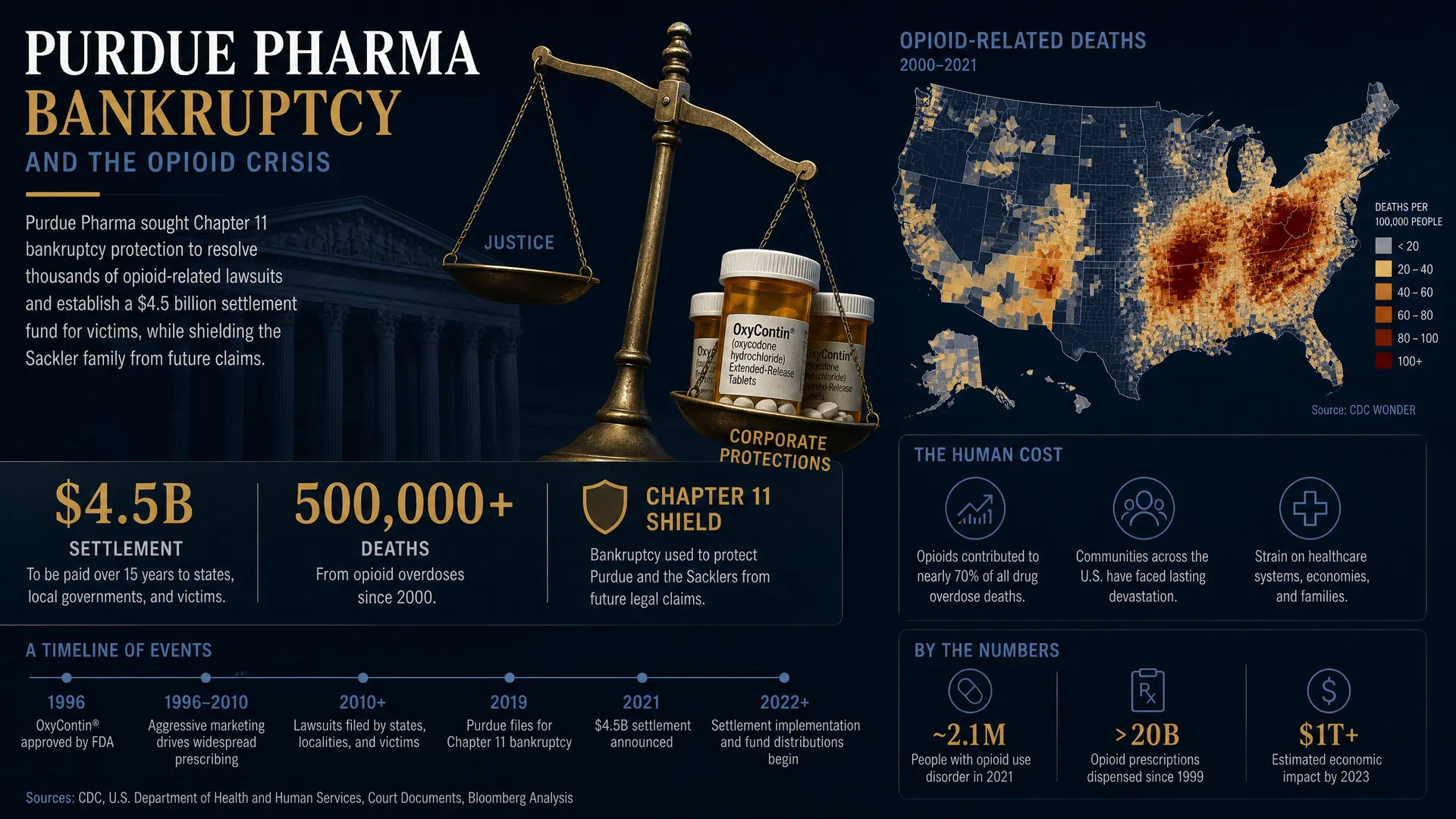
The U.S. Supreme Court's June 2024 ruling in Harrington v. Purdue Pharma L.P. said no. In a 5-4 decision, the Court held that the Bankruptcy Code does not permit the kind of "nonconsensual third-party release" that the Purdue reorganization plan had proposed. The ruling was a landmark not just for the Purdue case but for the entire landscape of mass-tort bankruptcy — a legal strategy that dozens of companies facing large-scale civil liability had adopted or were considering.
This article uses data from the CDC, the Joint Economic Committee, the Supreme Court record, and the DOJ to tell the full story of how a pharmaceutical company, a family fortune, and a public health crisis collided in federal bankruptcy court.
$35 Billion Made, $1.5 Trillion Lost
The data juxtaposition at the heart of this story is stark enough to require careful framing. Purdue Pharma's $35 billion in OxyContin revenue was earned over approximately 25 years, from the drug's introduction in 1996 through the company's bankruptcy filing in 2019. The $1.5 trillion economic cost of the opioid epidemic is an annual figure — the estimated cost to the U.S. economy in 2020 alone, representing a 37% increase from the $1.1 trillion estimated for 2017. [^1]
The economic cost estimate, produced by the Joint Economic Committee, includes four major categories: lost productivity (the largest component, reflecting deaths and disability among working-age adults), healthcare costs (treatment, emergency response, and long-term care), criminal justice costs (incarceration, policing, and court proceedings), and other social costs. The scale of the figure — $1.5 trillion in a single year — reflects the fact that the opioid epidemic has killed more Americans than any war since World War II.
The following table provides the key data points that define the scope of the crisis:
| Data Point | Statistic | Source |
|---|---|---|
| Annual U.S. opioid overdose deaths (2023) | ~80,000 opioid-involved deaths out of ~105,000 total drug overdose deaths | CDC, Jun 2025 |
| Peak annual overdose deaths | ~114,000 (12-month period ending Sept 2023) | CDC, Feb 2025 |
| Decline in overdose deaths (2024) | ~24% decline to ~87,000 (Oct 2023 – Sept 2024) | CDC, Feb 2025 |
| Economic cost of opioid epidemic (2020) | ~$1.5 trillion (up 37% from 2017) | Joint Economic Committee, Sep 2022 |
| Purdue Pharma OxyContin revenue | Estimated $35 billion lifetime; $2.8 billion in profits in the 1990s alone | 60 Minutes / Finance Uncovered |
| Sackler family proposed settlement | $6 billion to $7.4 billion in exchange for civil immunity | NPR, Jan 2025 |
| Purdue's 2007 federal fine | $635 million for misbranding OxyContin | DOJ, 2007 |
| Sackler family pre-bankruptcy withdrawals | Estimated $10-11 billion withdrawn from Purdue before bankruptcy | Court filings |
Sources: CDC; Joint Economic Committee; DOJ; court documents.
The 24% decline in overdose deaths documented by the CDC for the period October 2023 through September 2024 is a significant development — the first sustained decline in the epidemic's trajectory in years. Public health researchers attribute it to a combination of factors: increased availability of naloxone (the opioid reversal medication), expanded access to medication-assisted treatment, and, paradoxically, a shift in the illicit drug supply that may have reduced the concentration of fentanyl in some markets. The decline does not, however, alter the fundamental assessment of the epidemic's toll: approximately 500,000 Americans have died from opioid overdoses since 1999.
OxyContin and the Making of an Epidemic
OxyContin was approved by the FDA in 1995 and introduced to the market in 1996. It was marketed by Purdue Pharma as a breakthrough pain medication — a controlled-release formulation of oxycodone that, the company claimed, provided 12 hours of pain relief with a lower risk of addiction than immediate-release opioids. This claim was central to Purdue's marketing strategy and, as subsequent investigations established, was not supported by the available evidence.
Purdue's sales force was trained to emphasize OxyContin's purported low addiction risk to physicians. The company used a system of incentive payments to reward sales representatives who achieved high prescription volumes. It distributed promotional materials that minimized the drug's addiction potential and funded continuing medical education programs that promoted aggressive opioid prescribing for chronic pain conditions.
The consequences were predictable in retrospect. OxyContin prescriptions grew from approximately 300,000 in 1996 to approximately 7.2 million in 2002. As prescriptions proliferated, so did diversion — the practice of obtaining prescription opioids for non-medical use. OxyContin tablets could be crushed and snorted or dissolved and injected, bypassing the controlled-release mechanism and delivering a powerful opioid high. By the early 2000s, OxyContin abuse had become a significant public health problem in communities across the country, particularly in rural Appalachia and the Midwest.
The Science of Addiction, Ignored
In 2007, Purdue Pharma and three of its executives pleaded guilty to federal criminal charges of misbranding OxyContin by claiming it was less addictive than competing opioids. The company paid $635 million in fines — at the time, one of the largest settlements ever reached in a pharmaceutical criminal case. [^2] The executives paid $34.5 million in additional fines.
The 2007 guilty plea established, as a matter of federal criminal law, that Purdue had knowingly misrepresented OxyContin's addiction risk. Yet the company continued to market OxyContin aggressively for more than a decade after the plea. Annual OxyContin sales peaked at approximately $3 billion in 2010. The Sackler family, which controlled Purdue through a complex ownership structure, withdrew an estimated $10-11 billion from the company in the years before the bankruptcy filing — a fact that would become central to the subsequent litigation.
The Three Waves of the Opioid Crisis
The CDC and public health researchers describe the opioid epidemic as occurring in three distinct waves, each driven by a different primary substance. Understanding this framework is essential for interpreting the death toll data and for assessing the relationship between Purdue's conduct and the epidemic's current trajectory.
| Wave | Period | Primary Driver | Key Statistic |
|---|---|---|---|
| Wave 1 | 1990s–2010 | Prescription opioids (OxyContin, Vicodin) | Overdose deaths from prescription opioids quadrupled from 1999-2010 |
| Wave 2 | 2010–2013 | Heroin (as prescription opioid access tightened) | Heroin overdose death rates began climbing sharply in 2010 |
| Wave 3 | 2013–Present | Illicit synthetic opioids (fentanyl) | Fentanyl now drives ~76% of all opioid overdose deaths |
Source: CDC, "Understanding the Opioid Overdose Epidemic," 2025.
The three-wave framework reveals a critical dynamic: each policy intervention designed to address one wave inadvertently contributed to the next. When regulators and physicians began restricting OxyContin prescriptions in the early 2010s, many people who had become dependent on prescription opioids turned to heroin as a cheaper and more accessible alternative. When law enforcement cracked down on heroin supply chains, illicit drug manufacturers responded by introducing fentanyl — a synthetic opioid approximately 100 times more potent than morphine — into the drug supply. Fentanyl is now the primary driver of overdose deaths, accounting for approximately 76% of all opioid-related fatalities.
The implication is sobering: even if Purdue Pharma had never existed, the opioid epidemic would not have ended with the restriction of OxyContin prescriptions. The epidemic had evolved beyond its origins. But the originating role of prescription opioids — and of Purdue's marketing practices specifically — in creating a population of opioid-dependent individuals who subsequently transitioned to heroin and fentanyl is well-documented in the public health literature.
The Bankruptcy Gambit
Purdue Pharma filed for Chapter 11 bankruptcy in the Southern District of New York on September 15, 2019. The filing was not a surprise — the company had been in settlement negotiations with state attorneys general for months, and the scale of the civil liability it faced made some form of restructuring inevitable. By the time of the filing, Purdue faced approximately 2,600 lawsuits from states, municipalities, hospitals, and individuals.
The bankruptcy filing triggered the automatic stay, halting all pending litigation. But the most consequential element of the proposed reorganization plan was not the stay — it was the proposed treatment of the Sackler family.
The Sackler family members who owned Purdue had not filed for personal bankruptcy. They were not debtors in the proceeding. Yet the proposed reorganization plan included a provision that would grant them broad immunity from future civil opioid lawsuits in exchange for their contribution of $4.5 billion (later increased to $6-7.4 billion) to the settlement fund. This provision — known as a "nonconsensual third-party release" — would have protected the Sacklers from civil liability without requiring them to submit to the bankruptcy process themselves or disclose their full financial circumstances.
What Is a Nonconsensual Third-Party Release?
The concept of a third-party release in bankruptcy is not inherently controversial. In many reorganization cases, a debtor's reorganization plan includes provisions that release claims against parties other than the debtor itself — typically officers, directors, or guarantors whose cooperation is necessary to make the reorganization work. When all affected creditors consent to such a release, it is generally permissible.
The Purdue plan proposed something different: a release that would bind creditors who had not consented to it. The hundreds of thousands of individuals who had suffered harm from OxyContin — or whose family members had died from opioid overdoses — would be permanently barred from suing the Sackler family in any court, even if they had not agreed to the settlement terms and even if they believed the settlement was inadequate.
The legal basis for such a release was contested. Some courts had permitted nonconsensual third-party releases in extraordinary circumstances; others had rejected them as inconsistent with the Bankruptcy Code's structure. The Purdue case brought this circuit split to the Supreme Court.
The Victims' Dilemma
For the families of opioid victims, the Purdue bankruptcy presented an impossible choice. The proposed settlement offered real money — billions of dollars to be distributed to states, municipalities, and individual victims through a complex allocation process. Rejecting the settlement in pursuit of larger judgments against the Sackler family was a gamble: the family's assets were substantial but not unlimited, and litigation against them individually would take years and might ultimately yield less than the settlement.
The U.S. Trustee, a DOJ official who oversees bankruptcy proceedings, opposed the nonconsensual third-party release on the grounds that it exceeded the bankruptcy court's authority. Several state attorneys general also objected. But a majority of the creditor committee — representing the interests of the largest creditor groups — supported the plan, believing that the settlement was the best available outcome.
The tension between individual victims who wanted their day in court against the Sacklers and institutional creditors who wanted certainty and closure is a recurring feature of mass-tort bankruptcies. The Purdue case brought this tension into sharp relief, and the Supreme Court's decision to take the case reflected the significance of the legal question at stake.
The Supreme Court Says No
On June 27, 2024, the Supreme Court issued its decision in Harrington v. Purdue Pharma L.P. in a 5-4 ruling. Justice Neil Gorsuch wrote the majority opinion, joined by Justices Thomas, Alito, Barrett, and Jackson. Justice Kavanaugh wrote the dissent, joined by Chief Justice Roberts and Justices Sotomayor and Kagan.
The majority held that the Bankruptcy Code does not permit a reorganization plan to grant a nonconsensual release of claims against a non-debtor third party. The Court's reasoning was grounded in the text and structure of the Bankruptcy Code: the discharge provisions of the Code apply only to debtors who have submitted to the bankruptcy process and disclosed their assets. Extending discharge-like protection to non-debtors who have not filed for bankruptcy and have not disclosed their financial circumstances would, the majority held, be inconsistent with the Code's fundamental design.
"The Bankruptcy Code provides a discharge to 'the debtor.' It does not provide a discharge to anyone who might benefit from a debtor's reorganization plan." — Harrington v. Purdue Pharma L.P., 603 U.S. ___ (2024) (Gorsuch, J., majority).
The dissent argued that nonconsensual third-party releases had been used in bankruptcy cases for decades and that the majority's ruling would disrupt thousands of pending and future mass-tort bankruptcies. Justice Kavanaugh warned that the decision would make it impossible to resolve complex mass-tort cases through the bankruptcy system, forcing companies to litigate thousands of individual claims rather than achieving a global settlement.
What the 5-4 Decision Means for Mass-Tort Bankruptcies
The Harrington ruling has significant implications beyond the Purdue case. The mass-tort bankruptcy strategy — in which a company facing large-scale civil liability files for bankruptcy and proposes a reorganization plan that includes broad releases for affiliated parties — had been used in cases involving asbestos manufacturers, talc producers, and other companies facing mass personal injury claims. The ruling calls into question the viability of this strategy in its most aggressive form.
The practical consequence is that companies and their controlling shareholders can no longer use the bankruptcy system to obtain immunity from civil liability without themselves submitting to the bankruptcy process. If the Sackler family wants the protection of a bankruptcy discharge, they must file for personal bankruptcy, disclose their assets, and submit to the scrutiny of the bankruptcy court. The Harrington decision restores this basic principle.
Where Does the Money Go Now?
Following the Supreme Court's ruling, the Purdue bankruptcy proceedings continued with the task of constructing a new reorganization plan that did not include the nonconsensual third-party releases. In January 2025, a revised settlement was announced: the Sackler family agreed to contribute $6 billion to $7.4 billion to a settlement fund, without receiving the broad civil immunity that the original plan had proposed. [^3]
The settlement funds are to be distributed through a complex allocation process that prioritizes several categories of claimants. State and local governments receive the largest share, to be used for opioid abatement programs. Individual victims and their families receive payments through a separate trust. Healthcare providers and other institutional claimants receive their own allocations.
The distribution process is expected to take years. Individual victim payments are likely to be modest — the scale of the harm vastly exceeds the settlement fund. But the Harrington ruling ensures that the Sackler family's contribution to the settlement is not accompanied by a legal shield that would prevent future accountability.
The Limits of Bankruptcy Law
The Purdue Pharma case reveals both the power and the limits of the American bankruptcy system as a mechanism for resolving large-scale social harms. The bankruptcy process is extraordinarily effective at what it was designed to do: provide an orderly forum for resolving competing claims against an insolvent debtor, allowing the debtor to reorganize or liquidate in a way that maximizes value for creditors. It is less well-suited to the task of compensating the victims of a public health catastrophe or holding wealthy individuals accountable for the conduct of companies they controlled.
The Harrington decision is a corrective, but it is not a complete solution. The Sackler family withdrew an estimated $10-11 billion from Purdue before the bankruptcy filing — money that is now beyond the reach of the bankruptcy estate. The $7.4 billion settlement, while substantial, represents a fraction of the family's extracted wealth and an infinitesimal fraction of the epidemic's economic cost.
For the attorneys who represent opioid victims, the case is a reminder that the bankruptcy system is one tool among many — and that its limitations are as important to understand as its capabilities. For the broader legal community, the Harrington ruling has clarified the boundaries of what bankruptcy courts can do, establishing that the discharge provisions of the Code are not infinitely elastic instruments that can be stretched to protect any party whose cooperation a reorganization plan requires.
The opioid epidemic continues. The legal reckoning it has produced is far from complete.
If you or a family member has been affected by the opioid crisis and are facing financial hardship, the attorneys in our directory can help. Find a bankruptcy attorney in your state or learn more about how bankruptcy can address medical debt and related financial distress.
For related data journalism, see our analysis of private equity's role in the retail apocalypse, non-dischargeable debt and the Alex Jones case, and the 2023 regional banking crisis.
References
[^1]: Joint Economic Committee, U.S. Congress. "The Economic Toll of the Opioid Crisis Reached Nearly $1.5 Trillion in 2020." September 2022. https://www.jec.senate.gov/public/index.cfm/democrats/2022/9/the-economic-toll-of-the-opioid-crisis-reached-nearly-1-5-trillion-in-2020
[^2]: U.S. Department of Justice. "Purdue Pharma L.P. and Three Current and Former Executives Plead Guilty to Federal Drug Charges." May 10, 2007.
[^3]: NPR. "Sackler Family Agrees to $7.4 Billion Settlement in Purdue Pharma Opioid Case." January 2025.
[^4]: U.S. Supreme Court. Harrington v. Purdue Pharma L.P., 603 U.S. ___ (2024). https://www.supremecourt.gov/opinions/23pdf/23-124_n7io.pdf
[^5]: CDC. "Understanding the Opioid Overdose Epidemic." 2025. https://www.cdc.gov/overdose-prevention/about/understanding-the-opioid-overdose-epidemic.html
[^6]: Private Equity Stakeholder Project. "Private Equity Bankruptcy Tracker." February 2026. https://pestakeholder.org/reports/private-equity-bankruptcy-tracker/