The $8 Billion Hole: A Data-Driven Autopsy of the FTX Crypto Collapse
On November 2, 2022, a single article changed everything. CoinDesk published a report revealing that the balance sheet of Alameda Research — the trading firm secretly controlled by FTX founder Sam Bankman-Fried — was heavily concentrated in FTT, the proprietary token issued by FTX itself. The circular nature of this arrangement was immediately apparent to anyone who understood it: FTX's affiliated trading firm was holding vast quantities of an asset whose value depended entirely on confidence in FTX. It was, in the language of financial analysis, a house of cards.
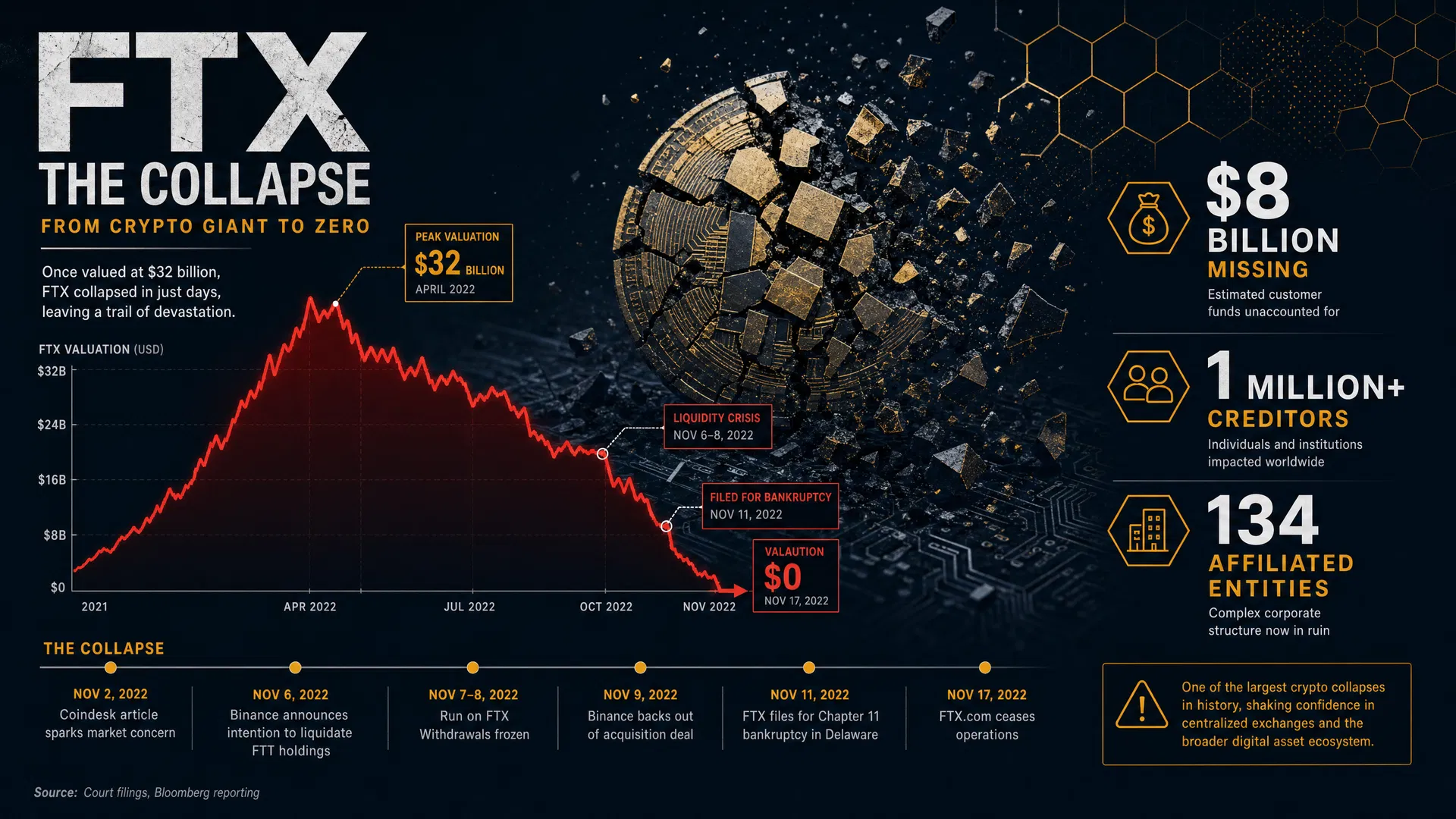
Nine days later, FTX had filed for Chapter 11 bankruptcy. A company that had been valued at $32 billion just months earlier — that had attracted investments from some of the most sophisticated institutional investors in the world, that had purchased naming rights to a Miami sports arena, that had run Super Bowl advertisements — was insolvent. Approximately $8.7 billion in customer funds were missing.
This article uses court documents, DOJ filings, and academic research to answer the question that every FTX customer, investor, and regulator was asking: how did $8 billion disappear, and where did it go?
Nine Days That Shook Crypto
The speed of the FTX collapse was itself a data story. The following timeline, reconstructed from court documents, news reports, and regulatory filings, shows how a decade's worth of apparent value was destroyed in less than two weeks.
| Date | Event |
|---|---|
| Nov 2, 2022 | CoinDesk publishes report revealing Alameda Research's balance sheet is dominated by FTT tokens |
| Nov 6, 2022 | Binance CEO Changpeng Zhao (CZ) tweets that Binance will liquidate its FTT holdings (~$530 million) |
| Nov 7, 2022 | SBF tweets "FTX is fine. Assets are fine." FTT price begins to collapse |
| Nov 8, 2022 | FTX halts customer withdrawals; FTT falls 77.34% in a single trading session |
| Nov 9, 2022 | Binance announces a non-binding letter of intent to acquire FTX; withdraws within hours after reviewing FTX's books |
| Nov 11, 2022 | FTX files for Chapter 11 bankruptcy; SBF resigns as CEO; John J. Ray III appointed as new CEO |
| Nov 12, 2022 | Ray states: "Never in my career have I seen such a complete failure of corporate controls" |
| Dec 12, 2022 | Sam Bankman-Fried arrested in the Bahamas |
| Nov 2, 2023 | SBF convicted on all seven counts of fraud, conspiracy, and money laundering |
| Mar 28, 2024 | SBF sentenced to 25 years in prison and ordered to forfeit $11 billion |
Sources: DOJ; FTX bankruptcy court filings; Investopedia; Chicago Fed Letter, 2023.
The 77.34% single-session price drop in FTT on November 8, 2022, was not merely a market event — it was the moment at which the circular accounting structure that had sustained FTX's apparent solvency became visible to everyone. When the value of FTT collapsed, the collateral underpinning Alameda Research's borrowings from FTX collapsed with it, exposing the gap between what FTX owed customers and what it actually held.
The $32 Billion Illusion
To understand how FTX reached a $32 billion valuation, it is necessary to understand the environment in which it grew. The period from 2020 to early 2022 was characterized by historically low interest rates, an unprecedented surge in retail participation in financial markets, and a speculative mania in cryptocurrency that saw the total market capitalization of digital assets reach approximately $3 trillion in November 2021.
FTX was founded in 2019 by Bankman-Fried and Gary Wang. It grew rapidly by offering sophisticated trading products — futures, options, leveraged tokens — that were not available on more conservative platforms like Coinbase. By 2021, it was processing tens of billions of dollars in daily trading volume and had attracted investment from prominent venture capital firms including Sequoia Capital, SoftBank, and the Ontario Teachers' Pension Plan.
The $32 billion valuation, achieved in a January 2022 funding round, was based on projections of continued growth in cryptocurrency trading volume and FTX's expanding market share. What investors did not know — and what the subsequent bankruptcy proceedings revealed — was that FTX was simultaneously operating as a de facto bank for its affiliated trading firm, Alameda Research, using customer deposits as the funding source.
The Alameda Relationship: A Fatal Conflict of Interest
Alameda Research was nominally a separate entity from FTX, but the two were deeply intertwined in ways that were not disclosed to customers or investors. Bankman-Fried controlled both organizations. Alameda had access to a special "backdoor" in FTX's accounting system that allowed it to borrow customer funds without triggering the automatic liquidation mechanisms that would have applied to any other borrower.
The DOJ's indictment and the subsequent trial testimony established that Alameda had borrowed billions of dollars in FTX customer funds, using the money for a range of purposes including venture investments, real estate purchases, and political donations. When cryptocurrency markets declined sharply in mid-2022 — the "crypto winter" that saw Bitcoin fall from approximately $68,000 to below $20,000 — Alameda's leveraged positions suffered catastrophic losses, and the borrowed customer funds could not be repaid.
The $8 Billion Question: Where Did Customer Money Go?
The bankruptcy proceedings revealed a financial structure of extraordinary complexity and opacity. John J. Ray III, the restructuring veteran who had previously overseen the Enron bankruptcy, described FTX's record-keeping as the worst he had encountered in four decades of professional experience.
The following table summarizes the key financial data from the bankruptcy proceedings:
| Data Point | Statistic | Source |
|---|---|---|
| Peak FTX valuation | $32 billion (January 2022) | Investopedia, 2024 |
| Total customer funds owed | $8.7 billion | Court Filings / Investopedia, Jun 2023 |
| Fiat/stablecoin share of missing funds | ~74% ($6.4 billion) | Investopedia, Jun 2023 |
| Total estimated liabilities | ~$23.2 billion (customers + non-customers) | Decentralised.co, Nov 2023 |
| Speed of bank run | 37% of customer funds withdrawn in ~2 days | Chicago Fed Letter, 2023 |
| FTT token price drop | -77.34% in a single trading session (Nov 8, 2022) | Esparcia et al., 2024 |
| SBF prison sentence | 25 years; ordered to pay $11 billion in forfeiture | DOJ, Mar 2024 |
| Potential creditors | 100,000+ creditors listed in bankruptcy petition | Rutgers Law, Dec 2022 |
Sources: DOJ; FTX bankruptcy court filings; Chicago Fed Letter on Crypto Runs of 2022.
The destination of the missing funds, as established by the DOJ and the bankruptcy trustee, fell into several categories. Approximately $11.2 billion in net assets were transferred from FTX to Alameda Research over the course of the exchange's operation. Of this amount, substantial sums were deployed in venture capital investments through FTX Ventures (including investments in companies such as Anthropic, which subsequently became highly valuable), real estate purchases in the Bahamas, and political donations to candidates of both major parties. A significant portion was also lost in Alameda's trading operations during the crypto winter of 2022.
The 74% fiat and stablecoin composition of the missing funds is particularly significant. It demonstrates that the shortfall was not primarily the result of cryptocurrency price volatility — it was the result of cash that had been removed from the exchange and deployed elsewhere. This distinction was central to the prosecution's case that the conduct constituted fraud rather than merely bad investment decisions.
The Crypto Winter Context
FTX did not collapse in isolation. The year 2022 was a period of cascading failures across the cryptocurrency industry, driven by the combination of rising interest rates, the collapse of the Terra/Luna ecosystem in May 2022, and the subsequent contagion that spread through heavily interconnected crypto lending platforms.
Celsius Network, which had marketed itself as a high-yield savings platform for cryptocurrency, filed for Chapter 11 bankruptcy in July 2022 with approximately $4.7 billion in liabilities. Voyager Digital, a crypto broker, filed for bankruptcy in the same month. BlockFi, a crypto lending platform that had received a $400 million credit facility from FTX in June 2022, filed for bankruptcy in November 2022 — just days after FTX itself collapsed, as the credit facility evaporated.
The Chicago Federal Reserve's 2023 analysis of the crypto runs of 2022 documented the speed and severity of the digital bank run on FTX: approximately 37% of customer funds were withdrawn in roughly two days once the CoinDesk article triggered a loss of confidence. [^1] This speed — far faster than any traditional bank run — reflects the frictionless nature of digital asset withdrawal and the absence of the regulatory mechanisms (deposit insurance, withdrawal limits, circuit breakers) that protect traditional bank depositors.
The FTX collapse is therefore best understood not as an isolated fraud but as the most dramatic expression of a systemic vulnerability that affected the entire crypto lending and exchange ecosystem. The absence of regulatory oversight, the opacity of balance sheets, and the interconnected nature of crypto firms created conditions in which a single disclosure could trigger a cascade of failures.
The Trial and the Sentence
Sam Bankman-Fried's criminal trial, conducted in the Southern District of New York in October and November 2023, was one of the most closely watched white-collar criminal proceedings in recent memory. The prosecution presented evidence that Bankman-Fried had knowingly directed the transfer of customer funds to Alameda Research, had lied to investors about the relationship between the two entities, and had used the misappropriated funds for personal enrichment and political influence.
The defense argued that Bankman-Fried had acted in good faith and had not understood the full extent of the financial problems at FTX. The jury rejected this defense, convicting him on all seven counts: wire fraud (two counts), securities fraud (two counts), commodities fraud, money laundering, and conspiracy to commit campaign finance violations.
On March 28, 2024, Judge Lewis Kaplan sentenced Bankman-Fried to 25 years in federal prison and ordered him to forfeit $11 billion. The sentence was among the longest ever imposed for a financial fraud conviction in the United States, reflecting both the scale of the harm and the judge's assessment of the defendant's culpability.
For context, the following table compares the FTX fraud to other major financial frauds in American history:
| Case | Estimated Losses | Criminal Outcome |
|---|---|---|
| Bernie Madoff Ponzi Scheme | ~$17 billion (net losses) | 150 years; died in prison 2021 |
| Enron | ~$74 billion (market cap loss) | Skilling: 24 years (reduced to 14) |
| WorldCom | ~$11 billion (accounting fraud) | Ebbers: 25 years |
| FTX / SBF | ~$8 billion (customer funds) | 25 years |
Sources: SEC; DOJ; court records.
The Recovery: Can Creditors Get Their Money Back?
The FTX bankruptcy proceedings have produced a more optimistic outcome for creditors than many initially expected. The bankruptcy estate, managed by John J. Ray III and the restructuring firm Sullivan & Cromwell, has pursued an aggressive asset recovery strategy that has included the liquidation of FTX's venture portfolio, the recovery of funds from political donations, and the pursuit of clawback claims against former executives and investors.
As of late 2025, the FTX estate had completed multiple rounds of creditor distributions. A third payout of approximately $1.6 billion was planned for September 2025. The estate has indicated that it expects to pay creditors at or near 100 cents on the dollar for their claims — an extraordinary outcome for a bankruptcy of this scale, attributable in part to the appreciation in value of some of the venture investments (particularly Anthropic) that Alameda had made with customer funds.
The recovery story is not uniformly positive. The 100-cents-on-the-dollar figure is calculated based on the value of claims at the time of the bankruptcy filing, not at current cryptocurrency prices. Many customers who held Bitcoin or Ethereum on FTX would have seen those assets appreciate substantially since November 2022, meaning that a dollar-denominated recovery at filing-date prices represents a real economic loss relative to what they would have held if the exchange had not failed.
What FTX Changed
The FTX collapse accelerated regulatory attention to cryptocurrency exchanges and lending platforms in ways that are still unfolding. In the United States, the Securities and Exchange Commission and the Commodity Futures Trading Commission have both intensified enforcement actions against crypto firms, and Congress has continued to debate comprehensive cryptocurrency legislation.
The case has also produced important legal precedents regarding the treatment of customer assets in cryptocurrency exchange bankruptcies. The question of whether customer cryptocurrency deposits constitute property of the bankruptcy estate — or remain the property of the customers — has been litigated in multiple proceedings, with courts reaching different conclusions depending on the specific terms of the exchange's user agreements.
For the broader bankruptcy system, the FTX case demonstrated that the Chapter 11 process can function effectively even in the most complex and chaotic circumstances. The appointment of an experienced restructuring professional, the aggressive pursuit of asset recovery, and the transparent communication with creditors produced an outcome that, while imperfect, was far better than a disorderly liquidation would have achieved.
The deeper lesson is about the relationship between financial innovation and regulatory oversight. The cryptocurrency industry grew to a multi-trillion-dollar market with minimal regulatory supervision, creating conditions in which fraud could flourish at scale. The FTX collapse, like the banking crises before it, is ultimately a story about what happens when financial intermediaries operate without the guardrails that protect depositors and investors in regulated markets.
If you are a creditor in a bankruptcy proceeding or facing financial distress, the attorneys in our directory can help. Find a bankruptcy attorney in your state or learn more about creditor rights in bankruptcy.
For related data journalism, see our analysis of the 2023 regional banking crisis, the retail apocalypse and private equity debt, and the financial mechanics behind celebrity bankruptcies.
References
[^1]: Chicago Federal Reserve. "Crypto Runs of 2022." Chicago Fed Letter No. 479, 2023. https://www.chicagofed.org/publications/chicago-fed-letter/2023/479
[^2]: U.S. Department of Justice, Southern District of New York. "Samuel Bankman-Fried Sentenced to 25 Years in Prison." March 28, 2024. https://www.justice.gov/usao-sdny/pr/samuel-bankman-fried-sentenced-25-years-prison
[^3]: Esparcia, C., et al. "The FTX Collapse: A Contagion Study in the Cryptocurrency Market." International Review of Financial Analysis, 2024.
[^4]: Rutgers Law Review. "FTX Bankruptcy: Legal Analysis." December 2022.
[^5]: Investopedia. "FTX Collapse: A Comprehensive Timeline." 2024.
[^6]: Decentralised.co. "FTX Bankruptcy: Total Liabilities Analysis." November 2023.
[^7]: U.S. Courts, Administrative Office. Bankruptcy Filings Statistics. https://www.uscourts.gov/data-news/reports/statistical-reports/bankruptcy-filings-statistics