In 1930, a bank run required people to physically line up outside a building. The images from that era — long queues of anxious depositors, tellers refusing to open windows, police maintaining order — are among the defining visual documents of the Great Depression. The mechanics were brutally simple: if enough people tried to withdraw their money simultaneously, the bank would run out of cash, and those who arrived too late would lose everything.
On March 9, 2023, Silicon Valley Bank experienced a bank run of a different kind. There were no queues. There were no tellers. There was no visible panic on the streets of Santa Clara. Instead, $42 billion in withdrawal requests arrived in a single day through mobile banking applications, accelerated by panic spreading through private venture capital WhatsApp groups and Twitter. By the following morning, the California Department of Financial Protection and Innovation had closed the bank and appointed the Federal Deposit Insurance Corporation as receiver.
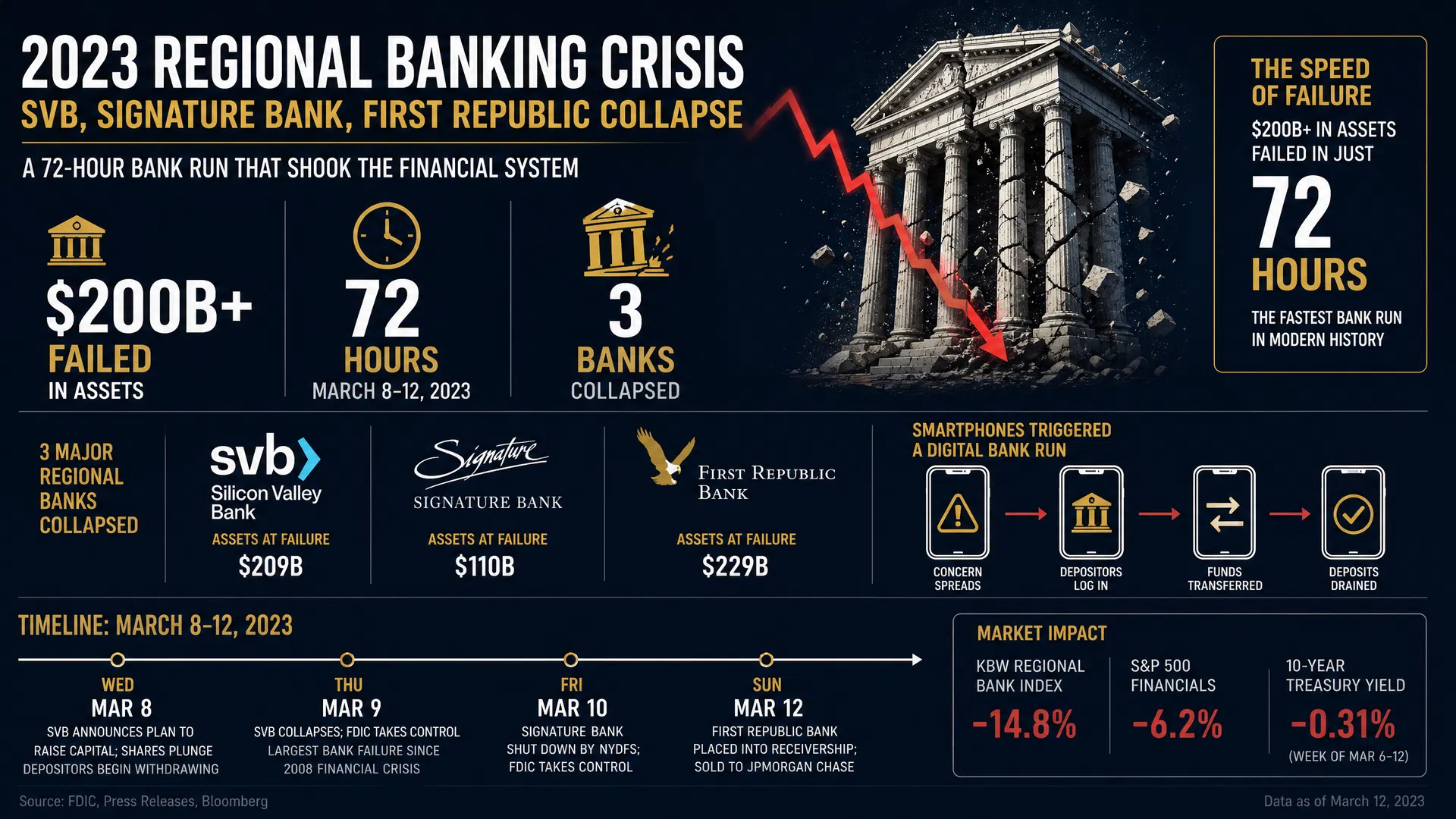
The 2023 regional banking crisis produced three of the largest bank failures in American history in the span of eight weeks. Understanding how it happened requires understanding the specific vulnerabilities that made these institutions uniquely susceptible to a digital-age bank run — and what the data reveals about the systemic risks that remain.
The $42 Billion Day
Silicon Valley Bank's collapse was not the result of bad loans or criminal fraud. It was the result of a specific combination of balance sheet vulnerabilities that, when exposed to a concentrated and digitally connected depositor base, produced a catastrophic loss of confidence in a matter of hours.
The bank had grown explosively during the low-interest-rate era of 2019-2022. Total assets tripled from approximately $71 billion to $212 billion in three years, driven by an influx of deposits from the technology startup ecosystem that SVB served. [^1] As deposits poured in, the bank needed to deploy them in interest-earning assets. With short-term interest rates near zero, SVB invested heavily in long-term government bonds and mortgage-backed securities — assets that offered higher yields but carried significant interest rate risk.
By the end of 2022, approximately 44% of SVB's total assets were held in a "Held-to-Maturity" (HTM) bond portfolio. [^2] Under accounting rules, HTM securities are not marked to market — their value on the balance sheet does not change as interest rates move. This accounting treatment concealed a critical vulnerability: as the Federal Reserve raised interest rates from near zero in March 2022 to over 5% by mid-2023, the market value of SVB's bond portfolio fell sharply. The unrealized losses on the HTM portfolio reached an estimated $15-17 billion by early 2023. [^1]
The crisis was triggered on March 8, 2023, when SVB announced that it had sold $21 billion of its available-for-sale securities portfolio at a $1.8 billion loss, and that it needed to raise $2.25 billion in new capital to shore up its balance sheet. The announcement was intended to reassure investors. Instead, it revealed the extent of the bank's interest rate exposure and triggered the panic it was designed to prevent.
How SVB Got Here: A Decade of Unchecked Growth
The Federal Reserve's own post-mortem on SVB's failure, published in September 2023, is one of the most candid self-critical documents ever produced by a federal financial regulator. [^1] The report acknowledged that the Fed's supervisors had identified SVB's interest rate risk and liquidity vulnerabilities as early as 2021 but had failed to take sufficient action to require the bank to address them.
The report attributed this failure to a combination of factors: the bank's rapid growth had outpaced the supervisory resources devoted to it; regulatory changes enacted in 2018 had reduced the frequency and intensity of examinations for banks in SVB's size category; and the supervisory culture had become excessively deferential to bank management.
The following table summarizes SVB's key financial metrics at the time of failure:
| Metric | Value | Context |
|---|---|---|
| Total assets at failure | $209 billion | 2nd largest bank failure in U.S. history |
| Asset growth (2019-2022) | Tripled from $71B to $212B | Driven by tech startup deposit inflows |
| HTM securities as % of assets | 44% | Concentrated interest rate risk |
| Uninsured deposit share | >80% of liabilities | Far above industry average of ~40% |
| Unrealized HTM losses (early 2023) | ~$15-17 billion | Concealed by accounting treatment |
| Daily withdrawal attempt (Mar 9) | $42 billion | Equivalent to ~20% of total deposits |
Sources: Federal Reserve Board Material Loss Review, September 2023; Richmond Fed, 2024.
The Bond Portfolio That Became a Time Bomb
The interest rate trap that destroyed SVB can be understood through a simple illustration. In 2021, SVB purchased a 10-year Treasury bond with a face value of $1,000 at a yield of 1.5%. By early 2023, with the Federal Funds Rate above 4.5%, a newly issued 10-year Treasury bond yielded approximately 4%. The market value of SVB's 1.5% bond had fallen to approximately $750 — a 25% decline. Multiply this dynamic across a $91 billion HTM portfolio, and the scale of the problem becomes clear.
The critical distinction is between unrealized and realized losses. As long as SVB held the bonds to maturity, it would receive the full face value. The losses were "unrealized" — they existed on the market but not on the balance sheet. The problem arose when SVB needed to sell bonds to meet withdrawal requests. At that point, the unrealized losses became real, crystallizing the $1.8 billion loss that triggered the bank run.
The Anatomy of a Modern Bank Run
The speed and mechanism of SVB's collapse represent a qualitative departure from historical bank runs that has significant implications for financial stability regulation. The following timeline documents the 48-hour sequence that destroyed a $209 billion institution:
| Date/Time | Event |
|---|---|
| Mar 8, 2023 (evening) | SVB announces $1.8B loss on bond sale and $2.25B capital raise |
| Mar 8-9 (overnight) | Prominent VC firms (including Founders Fund) advise portfolio companies to withdraw deposits; panic spreads via WhatsApp and Twitter |
| Mar 9 (business hours) | $42 billion in withdrawal requests submitted; SVB's stock falls 60% |
| Mar 9 (after market close) | SVB announces it has abandoned the capital raise; stock halted |
| Mar 10 (pre-market) | California regulators close SVB; FDIC appointed as receiver |
Sources: Federal Reserve Board Material Loss Review; multiple news reports.
The role of social media and private messaging platforms in accelerating the bank run is a defining feature of the 2023 crisis. Research published after the event documented how the concentration of SVB's depositor base in the venture capital ecosystem — a community characterized by dense social networks and rapid information sharing — created conditions for a coordinated withdrawal that no traditional bank run mechanism could have produced.
The Chicago Federal Reserve's analysis of the FTX collapse documented a similar dynamic: approximately 37% of FTX customer funds were withdrawn in roughly two days once the CoinDesk article triggered a loss of confidence. [^3] The parallel is instructive: both SVB and FTX were destroyed by digital bank runs that moved faster than any regulatory or management response could address. The common factor was a concentrated, digitally connected stakeholder base with the ability to coordinate withdrawal behavior at speed.
Contagion: Signature Bank and First Republic
SVB's failure triggered immediate contagion across the regional banking sector, producing two additional failures within eight weeks.
| Bank | Assets at Failure | Failure Date | Primary Cause | Resolution |
|---|---|---|---|---|
| Silicon Valley Bank | $209 billion | Mar 10, 2023 | HTM bond losses + uninsured depositor bank run | FDIC receivership; assets sold to First Citizens Bank |
| Signature Bank | $110 billion | Mar 12, 2023 | Crypto exposure + contagion from SVB panic | FDIC receivership; assets sold to Flagstar Bank |
| First Republic Bank | $229 billion | May 1, 2023 | Uninsured deposit flight; HTM losses | FDIC receivership; acquired by JPMorgan Chase |
Source: FDIC; Richmond Fed, 2024.
Signature Bank's failure was driven by a combination of its own vulnerabilities and the panic triggered by SVB. Signature had significant exposure to the cryptocurrency sector — approximately 20% of its deposits were from crypto-related businesses — and had been a banking partner to FTX before that exchange's collapse in November 2022. [^4] When SVB failed, depositors at other banks with concentrated or unusual depositor bases began withdrawing funds, and Signature's crypto-adjacent profile made it a target.
First Republic Bank's failure, which came seven weeks after SVB's, was the largest bank failure in U.S. history by assets. First Republic had a similar vulnerability profile to SVB: a concentrated depositor base (primarily high-net-worth individuals and businesses in coastal metropolitan areas), a large portfolio of low-rate mortgages and bonds that had declined in market value, and a high proportion of uninsured deposits. Despite a $30 billion deposit infusion from a consortium of large banks in March 2023 — an extraordinary private-sector rescue attempt — First Republic continued to hemorrhage deposits and was ultimately seized by regulators and sold to JPMorgan Chase.
The Regulatory Failure
The Federal Reserve's material loss review of SVB is notable for its candor about the regulatory failures that contributed to the crisis. The report identified several specific shortcomings:
First, the 2018 Economic Growth, Regulatory Relief, and Consumer Protection Act raised the threshold for enhanced prudential standards from $50 billion to $250 billion in assets. SVB, with $209 billion in assets at failure, fell below this threshold and was therefore subject to less intensive supervision than it would have been under the pre-2018 framework.
Second, the Fed's supervisors had identified SVB's interest rate risk and liquidity vulnerabilities in 2021 and 2022 but had not escalated their concerns or required remedial action with sufficient urgency. The report attributed this to a supervisory culture that was "too deferential to bank management."
Third, the rapid growth of SVB's balance sheet had outpaced the supervisory resources devoted to examining it. The bank's asset base tripled in three years, but the supervisory team assigned to it did not grow proportionally.
The regulatory failure at SVB is directly comparable to the failures documented in the FTX collapse: in both cases, regulators had visibility into the vulnerabilities but did not act with sufficient urgency to prevent the crisis.
The Extraordinary Response
The federal government's response to the 2023 banking crisis was unprecedented in its scope. On March 12, 2023 — two days after SVB's failure — the Treasury Department, the Federal Reserve, and the FDIC jointly announced that all depositors at SVB and Signature Bank, including those with deposits above the $250,000 FDIC insurance limit, would be made whole. This decision, made under the "systemic risk exception" to normal FDIC resolution procedures, effectively guaranteed approximately $150 billion in uninsured deposits at the two failed banks.
The decision was controversial. Critics argued that it represented a de facto expansion of deposit insurance without Congressional authorization, and that it created moral hazard by signaling that large depositors at systemically important institutions would always be protected. Supporters argued that the alternative — allowing large depositors to take losses — would have triggered a broader banking panic that could have caused far greater economic damage.
The systemic risk exception had previously been invoked only during the 2008 financial crisis. Its use in 2023 for regional banks that were not, by any standard definition, systemically important institutions represented a significant expansion of the federal government's implicit guarantee of the banking system.
Lessons for the Next Crisis
The 2023 banking crisis produced a set of regulatory and legislative responses that are still being implemented. The Federal Reserve has proposed strengthening capital and liquidity requirements for banks with assets between $100 billion and $250 billion — the size category that SVB and First Republic occupied. The Basel III endgame rules, which would require large banks to hold more capital against their trading and investment portfolios, have been debated extensively.
But the deeper lesson of the 2023 crisis is about the speed of modern financial contagion. The combination of digital banking, social media, and concentrated depositor bases creates conditions in which a loss of confidence can translate into a catastrophic bank run in hours rather than days. The regulatory frameworks developed in the aftermath of the 2008 financial crisis were designed for a world in which bank runs unfolded over days or weeks. The 2023 crisis demonstrated that this assumption no longer holds.
For businesses and individuals who maintain deposits above the FDIC insurance limit, the 2023 crisis was a reminder that the $250,000 guarantee is not a ceiling on risk — it is a floor on protection. The extraordinary government response in 2023 protected depositors who had made a rational decision to concentrate large deposits at a single institution. There is no guarantee that the same response would be available in a future crisis.
If your business is facing financial distress related to banking relationships or credit access, the attorneys in our directory can help. Find a bankruptcy attorney in your state or learn more about business bankruptcy options.
For related data journalism, see our analysis of the retail apocalypse and private equity debt, the FTX crypto collapse, and the financial mechanics behind celebrity bankruptcies.
References
[^1]: Federal Reserve Board. "Review of the Federal Reserve's Supervision and Regulation of Silicon Valley Bank." September 2023. https://oig.federalreserve.gov/reports/board-material-loss-review-silicon-valley-bank-sep2023.pdf
[^2]: SMU Cox School of Business. "Silicon Valley Bank: The Interest Rate Risk That Wasn't Managed." 2023.
[^3]: Chicago Federal Reserve. "Crypto Runs of 2022." Chicago Fed Letter No. 479, 2023. https://www.chicagofed.org/publications/chicago-fed-letter/2023/479
[^4]: FDIC. "Bank Failures in Brief." https://www.fdic.gov/resources/resolutions/bank-failures/in-brief/index
[^5]: Richmond Federal Reserve. "The 2023 Bank Failures: A Comparative Analysis." 2024.
[^6]: U.S. Courts, Administrative Office. Bankruptcy Filings Statistics, 2022–2025. https://www.uscourts.gov/data-news/reports/statistical-reports/bankruptcy-filings-statistics